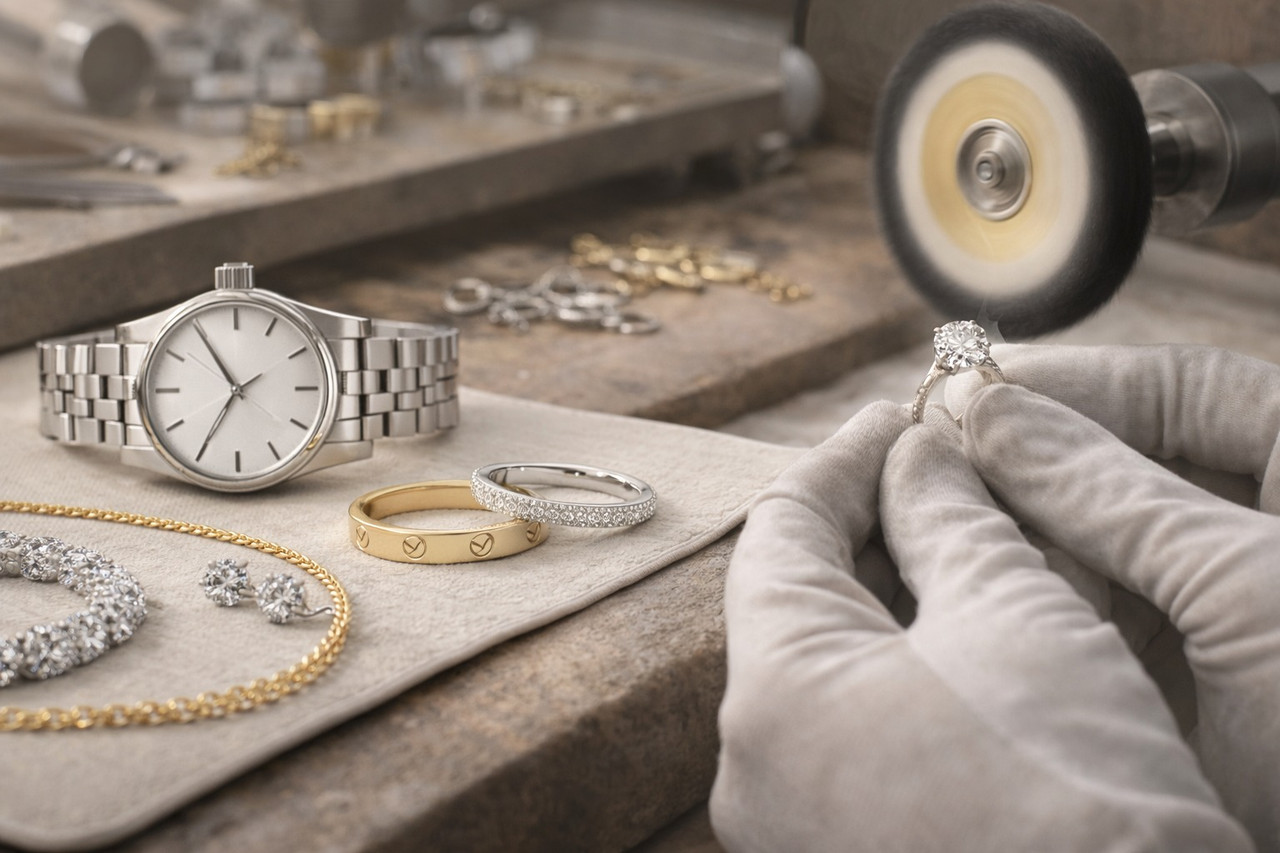
Most people accumulate a small collection of broken or unwearable items without ever intending to. A ring that no longer fits after a few years. A watch that stopped when its battery died and never got replaced. A necklace with a clasp that gives out at the worst moment. A pair of earrings missing a back. A bracelet that has been sitting in a dish since last spring. None of it feels urgent enough to schedule around, so it stays exactly where it is. That is precisely the gap filled by Professional Jewelry & Watch Services – Fast Fix at Annapolis Mall, where the whole point is that you can handle these things during a normal errand rather than building a separate project around them.
The value of a full service bench is that it covers an unusually broad range of problems under one roof. Watch work and jewelry work are genuinely different disciplines, requiring different tools, different training, and different instincts, yet the average household needs both regularly. Having them in the same place means a single visit can resolve a stopped watch, a resized ring, and a broken chain at once. For most people that is the difference between actually maintaining their jewelry and slowly building a drawer full of good intentions.
What the jewelry side of the bench typically handles
Ring sizing is one of the most requested services anywhere, and for good reason. Fingers change with weight, age, pregnancy, medication, and even the season, since hands swell noticeably in humid Maryland summers and shrink in cold weather. A ring that spins constantly is at risk of catching and bending, while one that is too tight becomes genuinely uncomfortable and sometimes unsafe. Sizing up or down involves cutting the shank, adding or removing metal, soldering the joint cleanly, and then reshaping and refinishing so the repair becomes invisible. On rings with stones set all the way around, or on certain tension settings and specialty metals, the approach changes considerably and sometimes sizing beads or an insert makes more sense than altering the band.
Stone work is another core area, and it deserves more attention than most owners give it. Prongs wear down over years of contact with clothing, countertops, and car doors. A prong that has thinned or flattened can release a stone without any warning at all, and the loss usually happens somewhere unrecoverable. Retipping and rebuilding prongs is routine preventive work that costs a fraction of replacing a lost diamond. Channel settings, pavé work, and bezels have their own failure modes, and a bench jeweler can identify a loose stone by touch and sound long before it becomes an emergency. If you own an engagement ring you wear daily, having the settings checked periodically is one of the smartest habits you can adopt.
Chain and bracelet repair covers everything from a simple soldered link to full clasp replacement. Many so called broken chains turn out to have perfectly good links and a worn out clasp, which is a much simpler and cheaper fix than people assume. Bracelets add complications like hinges, safety chains, stretched links, and pins that work loose over time. A thorough repair looks beyond the obvious break, because a chain that failed once often has neighboring links already thinned to the point of failing next.
Then there is the broad category of restoration and refresh work. Professional cleaning removes accumulated lotion, soap film, and skin oils that dull stones far more than people realize, and the difference after an ultrasonic and steam treatment often surprises owners. Rhodium plating restores the bright white finish on white gold, which naturally warms toward yellow as the plating wears. Polishing removes surface scratches, though a good jeweler applies restraint here, because aggressive polishing removes metal permanently and can soften the crisp lines of an antique or collectible piece. Engraving, pearl restringing, and custom modifications round out the offering.
Pearl restringing deserves a specific mention because it is so commonly neglected. Pearl strands are strung on silk or nylon, usually with knots between each pearl so that a break does not scatter the whole strand. That thread absorbs body oils and stretches over time. When the strand starts to sag or the gaps between pearls become visible, it is due for restringing. Waiting until it breaks means crawling around a floor hunting for pearls, which is exactly the situation the knots were meant to prevent.
What the watch side involves and why it is a separate skill
Battery replacement is the most common service by volume, and it is deceptively technical. Case backs come in several designs, each requiring the correct tool. Screw down backs need a case wrench with correctly sized pins. Snap backs need a case knife applied with controlled pressure. Some open from the front. Using the wrong approach leaves permanent crescent shaped gouges around the rim, which is why so many self service attempts end badly. Cell selection matters too, since watch batteries are identified by codes specifying diameter, thickness, chemistry, and voltage, and most watches use silver oxide cells rather than supermarket alkaline equivalents because they hold a flatter voltage curve across their life.
The step almost nobody outside the trade thinks about is the gasket. Water resistance depends on rubber seals compressed between case and back, and those seals harden and flatten with age and heat. Every time a case is opened, that gasket has been disturbed. Proper service includes inspecting it, cleaning the groove, and applying silicone grease so it seats evenly, then pressure testing afterward to confirm the case is actually sealed rather than assumed to be. In a humid coastal area, that verification matters considerably more than it does in a dry climate.
Beyond batteries, the watch bench handles crystal replacement, crown and stem work, chronograph pusher issues, bracelet sizing, spring bar replacement, and diagnostics on watches that stopped for reasons invisible from outside. Sometimes a watch that will not run has nothing wrong with the battery at all. It may be magnetized, which is remarkably common thanks to phone mounts, laptop closures, and speaker magnets, and which a technician can often correct in moments with a demagnetizer. It may have a seized gear train, a broken coil, or moisture damage. Distinguishing between those possibilities quickly is exactly what a trained eye provides.
For mechanical watches, full servicing is a substantially larger undertaking. The movement is disassembled completely, cleaned, worn components replaced, then reassembled and lubricated with multiple different oils applied in precise quantities at specific points. Afterward it is regulated on a timing machine across multiple positions, since a mechanical watch performs differently dial up, dial down, and crown down. Watch oils degrade over years regardless of use, and as they thin, friction increases and wear accelerates. This is why periodic service is recommended even on watches running apparently fine, and why owners who service on schedule generally spend less across a lifetime than those who wait for a stoppage.
Why the walk in model changes behavior
The practical argument is straightforward but powerful. Mailing jewelry or a watch to a distant workshop means packaging, insuring, waiting, and worrying about a valuable or sentimental object in transit. A location you already pass while shopping removes nearly all of that friction. Drop the item off, continue your errands, and collect it before you leave. Many services are completed same day. For maintenance that people postpone precisely because it feels inconvenient, that convenience determines whether it happens at all.
There is also genuine value in speaking with someone while the item is in front of both of you. Photographs miss thinning links, worn prongs, hairline cracks, soft clasp springs, and moisture damage that only shows under magnification and good lighting. A professional can tell you whether you are dealing with a one time failure or a symptom of general wear, whether the clasp is the real weak point, and whether a repair makes economic sense in the first place. That last point matters. Not every piece is worth restoring, and a shop willing to say so directly rather than quoting work on a thin plated fashion item is demonstrating exactly the honesty you want.
Sentimental pieces change the calculation entirely, and a good bench understands that. A ring inherited from a grandmother, a watch received at a retirement, a bracelet built from charms collected over decades, or a christening chain has value that no melt calculation captures. In those cases the goal is continuity rather than mere function. Matching metal color, preserving original character, avoiding over polishing, and keeping the piece recognizably itself all become part of the work. Bring loose fragments, detached charms, and any stones you managed to recover, because actual parts are far easier to work with than descriptions.
A few habits meaningfully reduce how often you need repairs. Put jewelry on after lotion, perfume, sunscreen, and hairspray rather than before. Remove rings and bracelets for workouts, gardening, cleaning, and anything involving heavy lifting. Take everything off before swimming, since chlorine and salt water are hard on both metals and finishes. Store pieces separately rather than tangled together in a shared box. Keep watches away from strong magnets and out of hot cars. And have daily wear items inspected occasionally, because catching a worn prong or thinning link early is dramatically cheaper than dealing with the consequences later.
When you do bring something in, a few questions improve the outcome. Ask what specifically failed and why. Ask whether additional weak points should be addressed while the piece is already open, since handling two emerging issues in one visit almost always beats three separate repairs across a year. Ask about turnaround honestly, since a battery is quick but a full mechanical service is not, and anyone promising a complete overhaul in an afternoon is not performing one. Ask about warranty on the work. And for watches, ask specifically whether gaskets will be replaced and whether pressure testing is included, because those two answers reveal a great deal about a shop's standards.
At the end of the day, what a professional bench delivers is not spectacle. It is the quiet return of things to working order. A ring that fits properly and stays put. Stones that are secure. A chain that closes with a confident click. A watch that runs accurately and stays sealed. None of that draws attention, which is exactly the point. Good jewelry and a good watch are supposed to be things you fasten without thinking about, and getting them back to that state is usually faster, cheaper, and less complicated than most people assume before they finally stop putting it off and simply walk in.


 en la parte superior derecha de la subsección.